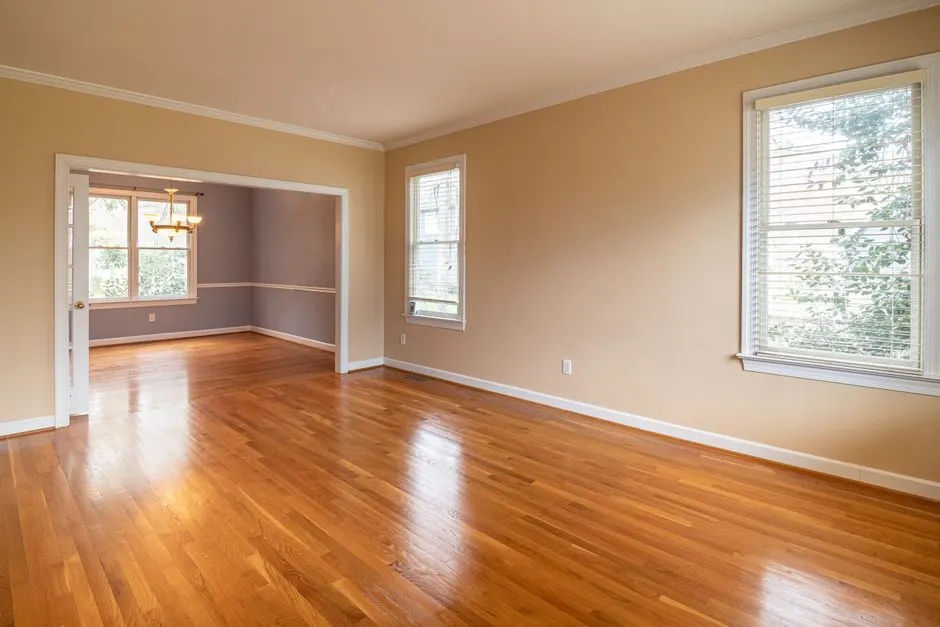
Protecting wood floors from Austin summer humidity means keeping indoor relative humidity between 35% and 55% year-round, sealing gaps around doors and windows, running AC or a dehumidifier consistently, and never wet-mopping. Austin's summer dew points regularly hit 70-75°F, and that moisture moves into your home every time a door opens. The rest of this post covers why it happens, what humidity level is safe, room-by-room fixes, and when to call us.
Why Austin summer humidity damages wood floors
Wood is hygroscopic, which means it absorbs and releases moisture from the air until it reaches equilibrium with its surroundings. When Austin's outdoor humidity climbs from 45% in the morning to 90% after an afternoon storm, your floorboards swell and shrink with every swing. That movement is normal - until it happens too fast or too far.
Solid oak expands roughly 1% in width for every 4% increase in moisture content. On a 4-inch-wide board, that is about 0.04 inches per board. Across a 20-foot room, the cumulative movement can exceed half an inch. That is why you see cupping (edges higher than the center), crowning (center higher than the edges), and random gaps that open and close with the weather.
Engineered and solid floors handle this differently. Engineered planks have a plywood core that moves less, so they tolerate Austin's swings better. Solid wood moves more but can be sanded and refinished multiple times. If you are still deciding which direction to go, our team installs both and can walk you through the trade-offs. We handle hardwood floor installation Austin TX for homeowners who want solid wood and engineered options side by side.
What humidity level is safe for hardwood floors in Austin TX?
The safe indoor range for hardwood floors in Austin is 35% to 55% relative humidity, with 45% as the sweet spot. Above 60%, boards swell and cupping starts. Below 30%, boards shrink and gaps open. Austin's outdoor summer humidity averages 65-75%, so without mechanical control, your indoor air will drift above 60% most afternoons.
You do not need a lab-grade hygrometer. A $15-$30 digital humidity monitor from any hardware store is accurate enough. Place one in the main living area and one in the room with the most wood. Check them at 7 a.m. and 4 p.m. for a week. If the afternoon reading is consistently above 55%, you have a moisture control problem.
Temperature matters too. Every 10°F increase in air temperature roughly doubles the amount of moisture air can hold. Austin summers push indoor temps to 78-80°F in many homes, which raises the ceiling on how much water vapor the air can carry. Keeping the thermostat at 74-76°F and the fan on AUTO (not ON) helps the system pull moisture out instead of recirculating it.
How do I protect my wood floors from Austin summer humidity?
Protecting wood floors from Austin summer humidity comes down to four controls: air sealing, dehumidification, cleaning habits, and seasonal timing. Here is what actually works in Central Texas homes.
1. Seal the envelope
Air leaks around doors, windows, and attic hatches let humid outdoor air in 24/7. A $5 tube of exterior-grade caulk and a $20 door sweep stop more moisture than a $300 dehumidifier running all day. Check the bottom of exterior doors with a dollar bill - if it slides out easily, you need a new sweep.
2. Run a dehumidifier correctly
A 30-pint portable dehumidifier handles a 500-700 sq ft area. Set it to 50% and empty the tank daily, or plumb the drain hose to a sink or outside. In Austin's July-September stretch, most homes need one running 8-12 hours a day. Whole-home dehumidifiers tied into the HVAC system cost $1,500-$2,800 installed in 2026 and handle the entire house without portable units in every room.
3. Clean without water
Wet mopping is the fastest way to ruin a wood floor in Austin. A damp microfiber mop is fine - the floor should be dry within 60 seconds. Never use a steam mop, never use a bucket of water, and never let spills sit. A pH-neutral wood floor cleaner applied to the mop head, not the floor, is the safest routine.
4. Time your projects
If you are planning a refinish or new install, schedule it for late fall or winter when indoor humidity is naturally lower. Summer installs are doable - we do them every year - but the floor needs 3-5 days to acclimate to indoor conditions before installation. Skipping acclimation is the number one cause of post-install gaps and buckling.
Room-by-room moisture control for Austin homes
Different rooms in an Austin home see different moisture loads. A kitchen with a dishwasher and a bathroom with a shower put far more water vapor into the air than a bedroom. Here is how to prioritize.
- Kitchen: Run the exhaust fan every time you cook or run the dishwasher. Check the ice maker line and dishwasher supply for slow drips. A single pinhole leak under a cabinet can warp a 3-foot section of flooring in under a week.
- Bathrooms: Run the exhaust fan for 15-20 minutes after every shower. If the mirror is still fogged after 10 minutes, the fan is undersized or clogged. Wood floors in hall bathrooms are the most common repair call we get.
- Living areas: Keep furniture off the floor during the humid months if possible. Area rugs trap moisture underneath and slow drying after a spill. If you have rugs, lift them monthly and let the floor breathe for a day.
- Bedrooms: Mattresses and box springs block airflow. Slide them away from the wall once a month and check for condensation on the floor beneath.
If you live in an older home - say a 1950s bungalow in Wood Flooring in Zilker or a 1970s ranch in Wood Flooring in Round Rock - the original pier-and-beam foundation lets more ground moisture into the crawl space. A $400-$900 crawl space vapor barrier pays for itself by keeping that moisture out of your floors.
Common mistakes that make humidity damage worse
The most common mistake we see in Austin is treating humidity damage like a cleaning problem instead of a moisture problem. Homeowners wipe up the cupping, crank the AC, and hope it flattens. It usually does not - not without addressing the source.
Here are the specific mistakes that turn a manageable issue into a full floor replacement:
- Wet-mopping or steam-mopping. Water sits in the seams and wicks into the core. One steam mop session can void a manufacturer warranty.
- Running the AC fan on ON instead of AUTO. The fan blows moisture off the evaporator coil back into the house when the compressor cycles off. AUTO lets the coil drain.
- Ignoring a dripping AC condensate line. A clogged condensate drain in the attic or closet drips onto the ceiling and then the floor. We see this every August.
- Placing potted plants directly on wood. Saucers overflow, and the bottom of the pot stays damp. Use a waterproof mat or a stand.
- Waiting too long to call. Cupping that is caught in the first 2-3 weeks can often be reversed by fixing the moisture source. Cupping that has been there for months usually requires sanding and refinishing.
If the damage has already set in, we can assess whether the floor needs a repair or a full refinish. Our team handles wood floor repair Austin TX for cupped, gapped, and water-damaged boards, and we can usually tell you within 15 minutes of walking the floor whether it is salvageable.
When to call a professional
Call a professional when the cupping is deeper than 1/16 inch, when gaps are wider than a credit card, when the floor feels soft or spongy underfoot, or when you see dark stains that look like mold. Those are signs the moisture has reached the subfloor, and no amount of dehumidifier running will fix it.
We also get calls when a homeowner is preparing to sell and needs the floor to look right for showings. In that case, a light sand and recoat can restore the surface without a full refinish. Our team at General Wood Flooring LLC handles everything from moisture assessments to full hardwood floor refinishing Austin TX, and we will tell you honestly if a repair is not worth the money.
Frequently Asked Questions
How do I protect my wood floors from Austin summer humidity?
Keep indoor humidity between 35% and 55% with AC and a dehumidifier, seal air leaks around doors and windows, never wet-mop, and run exhaust fans in kitchens and bathrooms. A $15-$30 hygrometer tells you exactly where you stand.
What humidity level is safe for hardwood floors in Austin TX?
35% to 55% relative humidity is safe, with 45% ideal. Austin's outdoor summer humidity averages 65-75%, so indoor mechanical control is required. Above 60%, boards swell and cup. Below 30%, gaps open.
Does Austin humidity damage wood floors?
Yes. Austin's summer dew points of 70-75°F push indoor humidity above 60% in most homes without AC or dehumidification. That causes cupping, crowning, gapping, and in severe cases, subfloor damage that requires professional repair.
How to prevent wood floor moisture damage in Austin Texas?
Seal air leaks, run a dehumidifier set to 50%, keep the thermostat at 74-76°F with the fan on AUTO, clean with a damp microfiber mop only, and address any plumbing or AC condensate drips within 24 hours.
Can cupped wood floors be fixed?
Cupping caught in the first 2-3 weeks can often be reversed by fixing the moisture source and letting the floor dry slowly. Cupping that has been present for months usually requires sanding and refinishing. We assess each floor in person before recommending a fix.
Get help with Wood Flooring in Austin
If your floors are already showing cupping, gapping, or water stains, we can assess the damage and give you a straight answer on repair versus replacement. Call General Wood Flooring LLC at 512 877 7960 to schedule a moisture assessment.